

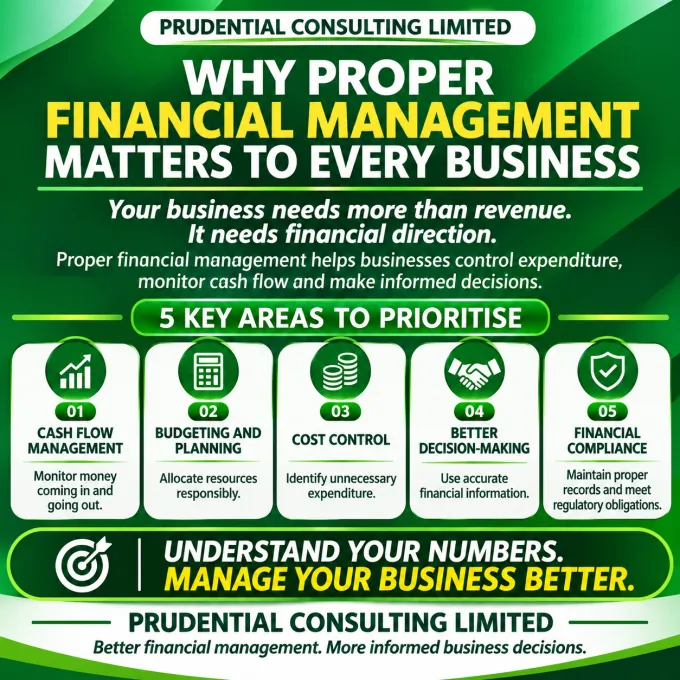
Why Proper Financial Management Matters to Every Business
How it works (in practical terms)
Financial management is not only bookkeeping. It includes:
- Recording and reconciliation:** capturing transactions, bank reconciliation, and documentation control.
- Budgeting and cashflow tracking:** planning inflows/outflows to reduce avoidable defaults.
- Expense classification and approvals:** ensuring costs are properly supported and coded.
- Periodic financial reporting:** producing monthly/quarterly statements for decisions and tax computation.
- Tax computation alignment:** linking accounts to tax rules for correct filings.
Step-by-step: How businesses invest responsibly
Investing decisions should be coordinated with cashflow and compliance:
1. Set objectives and time horizons:** working capital protection, growth projects, or asset acquisition.
2. **Build an emergency cash buffer:** avoid forced sales when expenses fall due.
3. **Assess risk and liquidity needs:** match investment tenors to expected cash availability.
4. **Plan for documentation:** maintain purchase agreements, invoices, and evidence for asset costs and any disposal.
5. **Consider tax treatment before committing:** understand whether returns are treated as business income, capital gains, or deductible/allowable costs.
6. **Use regulated channels and proper contracts:** employ licensed brokers/partners where relevant.
7. **Track investment performance and accounting treatment:** ensure changes in value or disposal are recorded correctly.
8. **Update tax computations during reporting cycles:** reconcile accounting profit to taxable income.
## Why it matters to tax payers
For tax payers, financial management supports:
- **Correct taxable income calculation:** preventing over- or under-reporting.
- **Claiming only allowable deductions/reliefs:** reducing exposure to disallowances.
- **Supporting withholding tax credits where applicable:** credits should be backed with valid documentation.
- **Audit readiness:** consistent records reduce the cost and disruption of tax queries.
- **Predictable cash planning:** taxes are easier to manage when cashflow is monitored.
Tax implications you must consider
While specifics depend on the tax regime (company or individual), common areas include:
- Business income treatment:** investment income may be part of trading/professional income depending on facts.
- Capital gains on disposal of assets:** profits from selling certain assets can attract capital gains tax implications.
- Capital allowances and allowable expenses:** certain investment costs may be treated as capital or deductible items under relevant rules.
- Withholding tax credits and reporting:** where withholding applies, proper records help align credits to returns.
(Professional confirmation is recommended for your exact investment structure and status.)*
Why every business should comply with tax regulation
Tax compliance protects operational continuity by:
- reducing penalties and interest from late filings or incorrect returns,
- improving access to financing and business partnerships through credible reporting,
- strengthening internal governance and decision quality,
- minimizing disputes with tax authorities through clear records.
Tax credit/relief opportunities (practical tips)
Common compliance-focused steps that can support allowable reliefs and credits include:
- maintain **fixed asset registers** and cost documentation for capital allowance computations,
- keep **invoices, payroll records, and contract documentation** to support deductions,
- reconcile **withholding tax certificates** (where applicable) with returns and accounting,
- track **permitted expenses** and exclude non-allowable items early,
- engage in **investment planning** that aligns with deductible/capital treatment requirements.
Where tax law relevance shows up
Tax law application becomes clear when you translate accounts into taxable figures:
- **Accounting profit ≠ taxable profit:** adjustments are often required.
- **Allowable deductions/capital treatment depend on statute and classification.
- **Filing obligations and record-keeping duties are enforced through tax administration rules.
Professional consulting to avoid error
Using a regulated, chartered tax and accounting professional such as PRUDENTIAL CONSULTING LIMITED (Chartered Accountant) helps ensure:
- consistency between your books and tax computations,
- documentation quality for audit and assessments,
- disciplined investment accounting aligned with tax reporting cycles,
- fewer avoidable mistakes caused by manual errors or incomplete records.
Where you need further assistant: Contact Professional Tax Consulting Firm in Lagos Nigeria on:
📞 WhatsApp: 08056219998
📧 Email: info@prudentialconsulting.com.ng
🌐 Website: https://www.prudentialconsulting.com.ng,
Extra Media
RELATED BLOG POSTS

How to Prepare Your Business for an External Audit
How to Prepare Your Business for an External Audit
An external audit examines your business records, controls, and tax-related documentation to support the assertions in your financial statements and, where applicable, to respond to tax assessment queries. For tax compliance purposes, audit...

Segregation of Duties: A Simple Control That Protects Businesses
**Segregation of Duties: A Simple Control That Protects Businesses**
Segregation of duties is an internal control principle that separates key responsibilities—such as authorization, record-keeping, custody of assets, and reconciliation—so that one person cannot complete an entire transaction from...
Fraud Risk: Why Internal Controls Matter in Every Business
Fraud Risk: Why Internal Controls Matter in Every Business
Fraud risk is not limited to large organizations. In Nigeria, businesses of every size face overlapping risks from weak governance, poor documentation, unreliable cash handling, lack of tax discipline, and incomplete records. For a business...

AI and the Future of Accounting

GUIDE TO START-UP INVESTMENT IN FEDERAL GOVERNMENT BONDS IN NIGERIA
Comments