

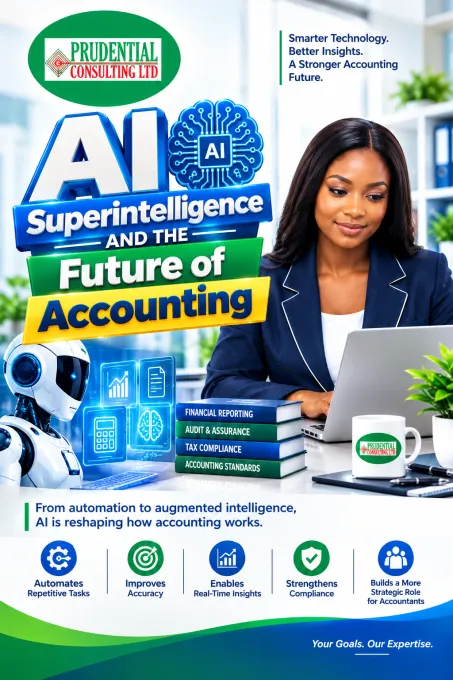
Artificial intelligence is changing how financial data is processed, reconciled, and reported. The Institute of Chartered Accountants of Nigeria (ICAN) has publicly affirmed that its members will adopt AI as a professional tool, while stressing that AI can enhance accounting work but cannot replace the integrity, transparency, and accountability that underpin the profession. For business owners, understanding this shift matters because it affects how bookkeeping, tax preparation, and financial reporting are likely to evolve, without changing the core obligation to comply with Nigerian tax law.
How AI Is Changing Accounting Work
AI tools are increasingly used to automate routine accounting tasks such as data entry, bank reconciliation, invoice matching, and preliminary categorization of transactions. ICAN's leadership has described this shift as moving the profession beyond what one former Accountant-General of the Federation called the era of purely manual "debit and credit" accounting, toward roles that require stronger analytical and interpretive judgment.
For a Nigerian business, this means:
- Faster processing of routine transactions, reducing the time spent on manual data entry.
- Earlier detection of anomalies, since AI-assisted tools can flag unusual transactions for review.
- A continued, and arguably greater, need for professional judgment, since AI systems process data according to patterns and rules, but do not independently verify the accuracy, context, or tax treatment of a transaction the way a qualified accountant does.
Step-by-Step: How a Business Should Approach AI in Its Financial Processes
- Use AI tools for efficiency, not for final judgment. Automated categorization and reconciliation tools can speed up bookkeeping, but the classification of expenses for tax purposes still requires professional review.
- Maintain human oversight of tax-sensitive entries. Items such as capital allowances, related-party transactions, and deductible versus non-deductible expenses require professional interpretation that current AI tools cannot reliably substitute for.
- Keep audit trails intact. Whatever system is used, ensure that underlying source documents, invoices, and receipts remain properly filed and retrievable, since the NRS may request supporting documentation regardless of how records were initially processed.
- Train staff on both the tools and their limits. ICAN has emphasized continuous training so that accountants use AI to strengthen, not replace, professional diligence.
- Have a qualified firm review AI-assisted records before filing. A professional review catches misclassifications that automated systems are prone to, particularly around Nigeria's specific tax rules.
Why This Matters to Nigerian Taxpayers
A tax return is only as accurate as the judgment applied to the underlying data, regardless of what technology assists in producing it. AI can improve the speed and consistency of record-keeping, but the responsibility for an accurate, compliant filing with the NRS remains with the business and its professional advisers. Errors introduced by uncritical reliance on automated categorization can still result in penalties under the Nigeria Tax Administration Act's consolidated penalty regime.
Tax Implications
- The use of AI tools in bookkeeping does not change the underlying tax treatment of any transaction; deductibility, capital allowance eligibility, and VAT treatment continue to follow the Nigeria Tax Act regardless of the software used.
- Businesses remain responsible for the accuracy of filings submitted to the NRS, whether prepared manually or with AI assistance.
- Proper documentation standards remain unchanged; AI-generated records still require supporting source documents to withstand a tax review.
Why Every Business Should Comply with Tax Regulation
Technology can improve efficiency, but it does not reduce the legal obligation to file accurately and on time. As the NRS strengthens its digital compliance monitoring capacity alongside the broader 2026 tax reforms, businesses that pair efficient record-keeping tools with proper professional oversight will be best positioned to meet these expectations without error.
The Advantage of Professional Oversight
A professional accounting and tax firm brings the judgment that AI tools are not designed to replace. This includes:
- Reviewing AI-categorised transactions for correct tax treatment before filing.
- Identifying deductions, allowances, and reliefs that automated systems may overlook or misapply.
- Ensuring that efficiency gains from technology do not come at the cost of compliance accuracy.
PRUDENTIAL CONSULTING LIMITED combines efficient record-keeping practices with professional review, ensuring that technology supports, rather than compromises, accurate tax compliance.
Relevant Tax Law
- Nigeria Tax Act, 2025, governing deductibility and capital allowance rules that remain unaffected by the accounting method or tools used.
- Nigeria Tax Administration Act, 2025, governing documentation and filing obligations.
- ICAN's professional and ethical standards, which continue to govern how members apply technology in practice.
Frequently Asked Questions
Can AI replace an accountant for tax filing purposes? No. AI can support data processing, but professional judgment remains necessary to correctly interpret and apply tax rules, and the filing responsibility remains with the taxpayer and their adviser.
Does using AI accounting software change what the NRS requires for documentation? No. Supporting source documents and audit trails are still required regardless of the software used to process transactions.
Is ICAN encouraging accountants to use AI? Yes. ICAN has affirmed that its members will adopt AI as a professional tool while maintaining the profession's core ethical standards of integrity, transparency, and accountability.
Where can I get further assistance? Contact Professional Tax Consulting Firm in Lagos, Nigeria on: 📞 WhatsApp: 08056219998 📧 Email: info@prudentialconsulting.com.ng 🌐 Website: https://www.prudentialconsulting.com.ng
This article is for general informational purposes and does not constitute complete investment, tax, or legal advice. Please consult a qualified professional before making financial or tax decisions specific to your business.
Extra Media
RELATED BLOG POSTS

GUIDE TO START-UP INVESTMENT IN FEDERAL GOVERNMENT BONDS IN NIGERIA
Comments