

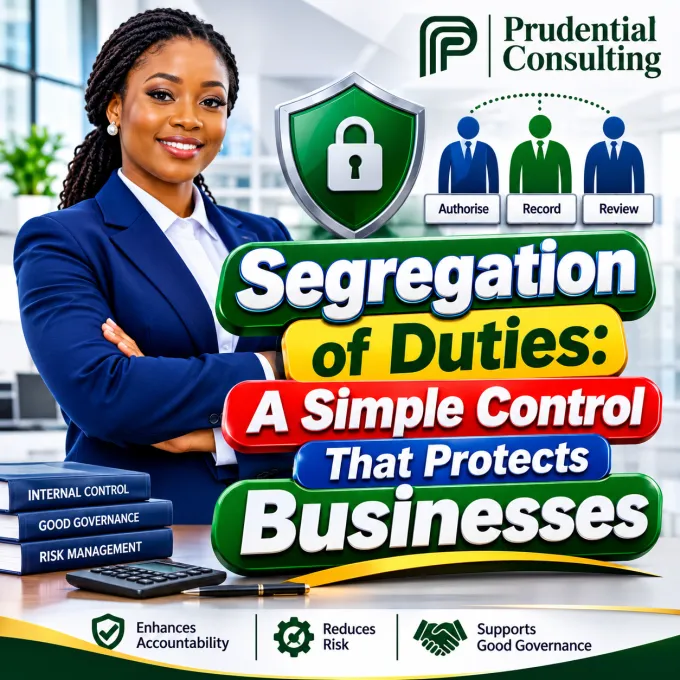
**Segregation of Duties: A Simple Control That Protects Businesses**
Segregation of duties is an internal control principle that separates key responsibilities—such as authorization, record-keeping, custody of assets, and reconciliation—so that one person cannot complete an entire transaction from start to finish. For a business regulated under Nigerian tax and accounting expectations, this control supports accurate tax computations and reduces errors that can lead to penalties, restatements, or disputes during tax
How it works (control logic)
In practice, segregation means:
- Approval** of transactions is done by one role.
- Processing/recording** is done by a different role.
- Asset custody/payment** is handled by another role.
- Reconciliation and review** are performed independently.
This structure creates checkpoints that detect mistakes early and strengthen accountability across payroll, purchases, sales, and banking activities.
Why it matters for tax payers
Tax returns depend on reliable records. When duties are mixed, tax computation errors are more likely—such as incorrect VAT treatment, wrong withholding calculations, or misclassification of expenses. The Nigeria Revenue Service (NRS) compliance approach is built on record integrity and audit readiness; therefore, stronger internal controls assist taxpayers to meet filing and documentation expectations.
Reference (NRS record integrity emphasis):** *NRS public compliance guidance on tax administration underscores the need for taxpayers to maintain accounting records that support tax returns and facilitate assessment and audit.*
Step-by-step: investing with control and tax awareness
1. Define the investment purpose** (equipment, software, project, or working capital) and classify it correctly under your chart of accounts.
2. Prepare an investment proposal** and obtain approval by management/authorized personnel (authorization duty).
3. Record the transaction** in the accounting system by a separate role (record-keeping duty).
4. Execute payment** only after approval and against supporting documents (custody/payment duty).
5. Reconcile accounts** (bank, vendor/contractor balances, and fixed asset register) by a different reviewer.
6. Link costs to tax treatment** (e.g., capital vs expense; applicable allowances) before filing.
7. Retain evidence**: invoices, contracts, delivery/acceptance, payment confirmations, and asset register entries.
This approach reduces the risk of overstating or understating deductible expenses and supports consistent treatment during tax assessments.
### Tax implications to consider (Nigeria)
Segregation of duties helps ensure correct application of relevant tax rules, for example:
- **Capital expenditure vs deductible expense:** Misclassification can affect **Companies Income Tax** computations and allowable deductions/allowances.
- **Withholding taxes (where applicable):** Errors in rates, bases, and remittance timing can trigger assessments and interest.
- **VAT accounting (where applicable):** Incorrect input/output VAT postings often stem from weak transaction controls.
### Tax credits, relief opportunities, and compliance tips
Depending on the business profile, taxpayers may seek qualifying incentives and reliefs through proper documentation, such as:
- **Investment allowances** and qualifying capital-based deductions (subject to eligibility and documentation).
- **Research and development-related deductions/allowances** where requirements are met.
- **Industry or status-based incentives** (for example, pioneer-related incentives under conditions prescribed by law, where applicable).
Key compliance tip: incentive claims should be supported by **approved documentation, timely records, and correct accounting classification**, which segregation of duties helps to achieve.
### Where tax law and compliance relevance applies
Nigerian tax administration expects taxpayers to compute tax based on accurate records and to provide evidence during assessment. Internal controls such as segregation of duties support:
- accurate tax computations under **Companies Income Tax Act** and related regulations,
- correct application of **VAT** rules where the business is registered,
- proper treatment of payments subject to **withholding tax**.
### Advantages of using a professional consulting firm
Using **PRUDENTIAL CONSULTING LIMITED (Chartered Accountant)** (or any qualified tax professional) supports control design and implementation by:
- mapping roles to ensure segregation is operational, not only documented,
- reviewing transaction flows for tax risk points (VAT, WHT, expense classification),
- advising on incentive eligibility and documentation requirements,
- strengthening audit trails to reduce avoidable disputes.
### Why every business should comply with tax regulation
Tax compliance supports correct assessments, reduces exposure to penalties and interest, and improves predictability for budgeting and investment decisions. When records are reliable and duties are separated, the business is better positioned to file returns that align with statutory requirements and to respond to queries with supporting evidence.
---
Where you need further assistant: Contact Professional Tax Consulting Firm in Lagos **Nigeria** on:
📞 WhatsApp: **08056219998**
📧 Email: **info@prudentialconsulting.com.ng**
🌐 Website: **https://www.prudentialconsulting.com.ng**
Extra Media
RELATED BLOG POSTS

How to Prepare Your Business for an External Audit
How to Prepare Your Business for an External Audit
An external audit examines your business records, controls, and tax-related documentation to support the assertions in your financial statements and, where applicable, to respond to tax assessment queries. For tax compliance purposes, audit...
Fraud Risk: Why Internal Controls Matter in Every Business
Fraud Risk: Why Internal Controls Matter in Every Business
Fraud risk is not limited to large organizations. In Nigeria, businesses of every size face overlapping risks from weak governance, poor documentation, unreliable cash handling, lack of tax discipline, and incomplete records. For a business...

Why Proper Financial Management Matters to Every Business
Why Proper Financial Management Matters to Every Business
How it works (in practical terms)
Financial management is not only bookkeeping. It includes:
- Recording and reconciliation:** capturing transactions, bank reconciliation, and documentation control.
- Budgeting and cashflow tracking:** planning...

AI and the Future of Accounting

GUIDE TO START-UP INVESTMENT IN FEDERAL GOVERNMENT BONDS IN NIGERIA
Comments