

The Role of Accountants in Business Decision-Making
The Role of Accountants in Business Decision-Making is central to how businesses plan, measure performance, control risk, and document compliance. Accountants translate business activities into financial information that managers and owners can evaluate, using evidence-based records, consistent accounting policies, and clearly supported tax computations.
**Nigeria Revenue Service (NRS) record-keeping reference:** NRS guidance commonly stresses that taxpayers should keep records that support tax positions—expressed as: **“Keep proper records and accounts that can support tax computations.”**
---
### How the role works (the mechanism)
Accountants support decision-making by:
- Recording transactions accurately:** sales, purchases, expenses, payroll, and payments.
- Classifying and reporting:** aligning transactions to a chart of accounts and management reporting structure.
- Forecasting with controls:** preparing budgets, cash flow projections, and variance analysis.
- Linking finance to tax:** ensuring allowable deductions, VAT/WHT treatment, and remittance schedules match statutory requirements.
- Providing audit-ready documentation:** supporting figures used in financial statements and tax returns.
---
Step-by-step: How to “invest” (through structured financial decision-making)
1. **Define the investment objective:** expansion, equipment purchase, working capital support, or technology adoption.
2. **Assemble reliable data:** past statements, bank records, payroll summaries, and an up-to-date trial balance.
3. **Model expected cash flows:** estimate inflows/outflows and timing (not only profit projections).
4. **Check tax and compliance impact:** confirm how the cost will be treated in tax computations and whether credits/reliefs may apply.
5. **Assess risk and financing options:** evaluate funding (equity, loans, retained earnings) and related obligations.
6. **Document the decision:** keep board/management minutes, assumptions, and support for the numbers.
7. **Monitor post-investment performance:** compare actuals vs budget and update forecasts for corrective action.
Why this is important to taxpayers
Accountants help taxpayers by ensuring that reported figures and tax computations are defensible. When records, schedules, and reconciliations are consistent, taxpayers can respond effectively to tax reviews, reduce disputes, and improve filing discipline.
Tax implication of weak accounting
Poor accounting records can lead to:
- incorrect VAT input/output balances,
- incomplete WHT schedules and mismatched credits,
- disallowed deductions due to missing or insufficient documentation,
- PAYE inconsistencies where payroll data is not properly captured.
---
Relevance tax law (where applicable)
In practice, businesses commonly rely on statutory obligations under **the Companies Income Tax Act (CITA)** for record-keeping and tax computation, alongside **the VAT Act** for VAT treatment and the **WHT framework under Nigeria’s tax administration rules** for withholding reporting. Exact applicability depends on entity type and business activity.
---
Nigeria tax credits, opportunities, and compliance tips
- **Track eligibility conditions early:** credits/reliefs usually require specific evidence and compliance steps.
- **Separate incentive-related records:** keep schedules for amounts claimed and supporting documentation.
- **Use consistent accounting and tax mapping:** ensure the same transaction is classified correctly for reporting and tax computation.
- **Avoid assumption-based claims:** verify qualifying criteria before including amounts in tax schedules.
---
Using a professional consulting firm to avoid error
A professional firm such as **PRUDENTIAL CONSULTING LIMITED (Chartered Accountant)** can support:
- tax computation review and documentation,
- VAT/WHT/PAYE schedule consistency checks,
- reconciliation of accounting figures to tax schedules,
- staff guidance on evidence requirements and controls.
Why every business should comply with tax regulation
Tax compliance depends on traceable records, correct computation, and timely returns. Compliance supports operational continuity, reduces avoidable exposures, and improves governance.
---
Where you need further assistant: Contact Professional Tax Consulting Firm in Lagos
Nigeria on:
📞 WhatsApp: 08056219998
📧 Email: info@prudentialconsulting.com.ng
🌐 Website: https://www.prudentialconsulting.com.ng
Extra Media

RELATED BLOG POSTS
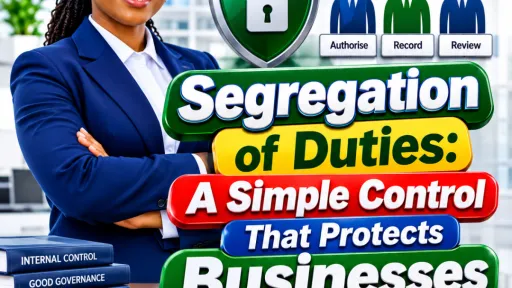
Segregation of Duties: A Simple Control That Protects Businesses
**Segregation of Duties: A Simple Control That Protects Businesses**
Segregation of duties is an internal control principle that separates key responsibilities—such as authorization, record-keeping, custody of assets, and reconciliation—so that one person cannot complete an entire transaction from...
Fraud Risk: Why Internal Controls Matter in Every Business
Fraud Risk: Why Internal Controls Matter in Every Business
Fraud risk is not limited to large organizations. In Nigeria, businesses of every size face overlapping risks from weak governance, poor documentation, unreliable cash handling, lack of tax discipline, and incomplete records. For a business...

Why Proper Financial Management Matters to Every Business
Why Proper Financial Management Matters to Every Business
How it works (in practical terms)
Financial management is not only bookkeeping. It includes:
- Recording and reconciliation:** capturing transactions, bank reconciliation, and documentation control.
- Budgeting and cashflow tracking:** planning...

AI and the Future of Accounting

GUIDE TO START-UP INVESTMENT IN FEDERAL GOVERNMENT BONDS IN NIGERIA
Comments