

Cloud Accounting: What Business Owners Should Know
Cloud accounting is an online accounting system that stores financial data on secure servers and supports remote access, approvals, and reporting. How it works in practice: transactions (sales, purchases, payroll-related entries, expenses) are captured in connected modules or imported files, coded to your chart of accounts, posted into ledgers, and organized into trial balance and financial statements. Reports can then be generated for internal management and tax schedules.
**NRS reference (record-keeping expectation):** Nigeria Revenue Service (NRS) compliance requirements consistently emphasize that taxpayers should **keep proper records** and supporting documentation that can substantiate the figures used in tax returns and computations. Cloud accounting supports this expectation by maintaining an electronic audit trail (invoices, journals, approvals, and period records).
Step-by-step: how to “invest” in cloud accounting
1. **Assess your current records** (chart of accounts, VAT/WHT coding, invoice format, reconciliation routines).
2. **Define scope** (core bookkeeping, VAT reporting, WHT schedules, payroll support, inventory).
3. **Map tax reporting needs** to system outputs (VAT output/input, WHT credits, CIT computation support).
4. **Migrate data carefully** (clean opening balances, consistent tax codes, documented adjustments).
5. **Set user permissions and approvals** (who enters, who reviews, who posts).
6. **Configure integrations** (bank feeds, invoicing, procurement, payroll where applicable).
7. **Run a parallel test period** to confirm that ledgers and tax schedules tie out.
8. **Document processes** (how transactions are captured, corrected, and archived).
Importance to taxpayers
Cloud accounting improves taxpayer readiness by reducing data loss, improving traceability of transactions, enabling consistent monthly reconciliations, and supporting faster responses to tax information requests.
Tax implications (what to watch)
Incorrect configuration can cause tax issues, such as wrong VAT treatment, incomplete WHT schedules, or expenses recorded without adequate supporting evidence affecting deductibility. Also, ensure the system maintains period cut-offs and retains original documents linked to each entry.
Tax law relevance (where it applies)
Businesses generally consider:
- **Companies Income Tax Act (CITA)**: deductions and computation rely on supported accounting records.
- **Value Added Tax (VAT) framework**: input/output VAT depends on proper invoicing and classification.
- **Withholding Tax (WHT) administration**: accurate schedules and documentation support credit treatment.
Using a professional consulting firm to avoid error
Engaging **PRUDENTIAL CONSULTING LIMITED (Chartered Accountant)** can help you set correct chart-of-accounts and tax-code mapping, confirm reconciliations tie to tax schedules, and establish documentation and approval controls consistent with professional practice.
Why every business should comply with tax regulation
Tax compliance depends on accurate records, correct computations, and timely returns. Strong accounting systems (including cloud accounting) support these obligations by making evidence retrievable and computations more consistent.
Nigeria tax credit and opportunities (practical guidance)
Where incentives/credits are available, claims usually require eligibility evidence and proper accounting treatment. A controlled cloud accounting setup helps organize qualifying costs, approvals, and supporting documents for substantiation during reviews.
Where you need further assistant: Contact Professional Tax Consulting Firm in Lagos
Nigeria on:
📞 WhatsApp: 08056219998
📧 Email: info@prudentialconsulting.com.ng
🌐 Website: https://www.prudentialconsulting.com.ng
Extra Media

RELATED BLOG POSTS
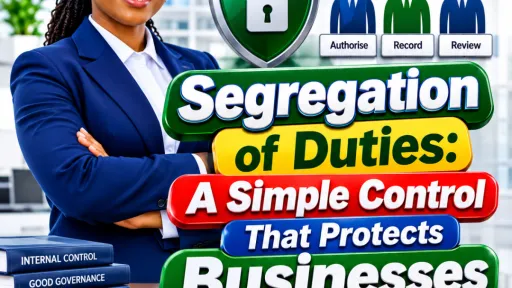
Segregation of Duties: A Simple Control That Protects Businesses
**Segregation of Duties: A Simple Control That Protects Businesses**
Segregation of duties is an internal control principle that separates key responsibilities—such as authorization, record-keeping, custody of assets, and reconciliation—so that one person cannot complete an entire transaction from...
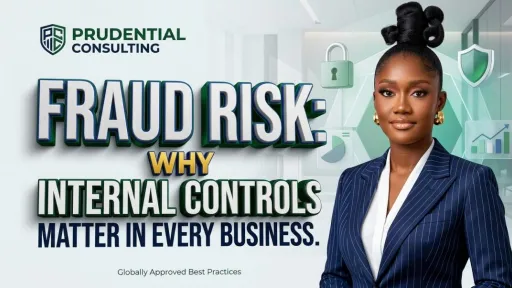
Fraud Risk: Why Internal Controls Matter in Every Business
Fraud Risk: Why Internal Controls Matter in Every Business
Fraud risk is not limited to large organizations. In Nigeria, businesses of every size face overlapping risks from weak governance, poor documentation, unreliable cash handling, lack of tax discipline, and incomplete records. For a business...

Why Proper Financial Management Matters to Every Business
Why Proper Financial Management Matters to Every Business
How it works (in practical terms)
Financial management is not only bookkeeping. It includes:
- Recording and reconciliation:** capturing transactions, bank reconciliation, and documentation control.
- Budgeting and cashflow tracking:** planning...

AI and the Future of Accounting

GUIDE TO START-UP INVESTMENT IN FEDERAL GOVERNMENT BONDS IN NIGERIA
Comments