

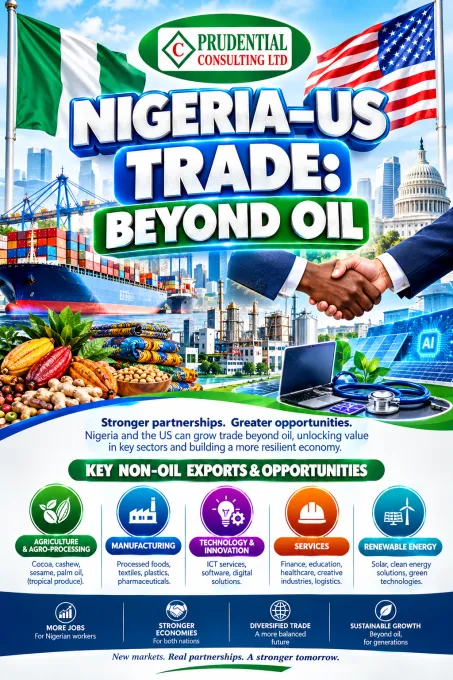
For decades, oil defined the Nigeria–US trade relationship. As both countries pursue energy diversification and global trade patterns shift, the non-oil dimension of this relationship has become more consequential, and more complicated. The United States has imposed a tariff of around 12.5 to 15 percent on Nigerian exports, a development Nigerian officials have acknowledged could disrupt the country's non-oil export ambitions and affect port revenue. For Nigerian businesses in agriculture, solid minerals, and manufacturing, understanding this shift is central to planning any US-facing trade strategy. How the Nigeria–US Trade Relationship Is Changing Historically, oil exports dominated Nigeria's trade with the United States, often overshadowing non-oil trade in both volume and policy attention. Several developments are now reshaping this picture: New US tariffs on Nigerian exports apply to non-oil goods, directly affecting the cost competitiveness of Nigerian agricultural and manufactured products in the US market. Nigeria's own export diversification strategy has prioritized reducing oil dependence, making non-oil market access increasingly important to national trade policy. Broader US tariff policy shifts affect how Nigerian goods compete against exporters from other countries with different tariff treatment in the US market. Nigerian officials have publicly encouraged exporters to look toward new markets as the competitiveness of US-bound non-oil exports comes under pressure from these tariffs. Step-by-Step: Navigating Non-Oil Trade With the US 1. Assess your product's specific tariff exposure. Tariff treatment can vary by product category, so a general awareness of "US tariffs" is not a substitute for checking your specific HS code classification. 2. Model the real cost impact on competitiveness. Calculate how the new tariff affects your landed cost in the US market relative to competitors from countries with different tariff treatment. 3. Explore market diversification alongside, not instead of, US engagement. Many businesses are expanding into AfCFTA markets while maintaining a reduced but strategic US presence. 4. Maintain accurate export documentation. This supports both US customs compliance and Nigerian tax treatment of export revenue. 5. Engage a professional firm to review the tax implications of any shift in market strategy. Changes in export destination, pricing, or structure can have tax consequences that should be assessed in advance. Why This Matters to Nigerian Taxpayers Businesses that have built their operations around a single major export market face concentrated risk when that market's tariff treatment changes. Properly documenting and tracking the tax implications of this shift, whether a business absorbs reduced margins, raises prices, or diversifies into new markets, ensures that taxable profit remains accurately reported throughout the transition. Tax Implications Export sales, including to the United States, are generally zero-rated for VAT purposes under Nigerian tax law, subject to proper documentation of the export transaction. Reduced margins resulting from new US tariffs should be reflected accurately in financial statements and tax computations, rather than smoothed over in a way that distorts reported profit. Costs associated with market diversification, including new market research, certification, and compliance costs for alternative export destinations, are generally deductible as business expenses where properly documented. Why Every Business Should Comply with Tax Regulation As Nigeria's non-oil export relationship with the United States faces new cost pressure, businesses that maintain clean, accurate tax and financial records are better positioned to demonstrate their true financial position to lenders, trade finance providers, and potential new market partners during this transition. The Advantage of Professional Guidance A professional consulting firm helps a business: Accurately assess and document the tax implications of reduced margins from new US tariffs. Evaluate the compliance requirements of diversifying into alternative export markets. Maintain the documentation needed to support VAT zero-rating on export transactions. PRUDENTIAL CONSULTING LIMITED helps Nigerian exporters manage the tax and financial implications of a changing Nigeria–US trade relationship. Relevant Tax Law Nigeria Tax Act, 2025, including VAT treatment of exports. Nigeria Tax Administration Act, 2025. Frequently Asked Questions Does the new US tariff apply to all Nigerian exports? Tariff treatment varies by product category, so businesses should confirm the specific classification and rate applicable to their goods rather than assume a blanket rate. Are Nigerian exports to the US still VAT zero-rated? Yes, qualifying exports remain zero-rated for VAT purposes under Nigerian tax law, regardless of the destination market's tariff treatment, provided proper documentation is maintained. Should businesses abandon the US market in response to new tariffs? Not necessarily. Many businesses are pursuing diversification alongside continued, strategically adjusted US engagement, depending on their specific product competitiveness. Where can I get further assistance? Contact Professional Tax Consulting Firm in Lagos, Nigeria on: 📞 WhatsApp: 08056219998 📧 Email: info@prudentialconsulting.com.ng 🌐 Website: https://www.prudentialconsulting.com.ng This article is for general informational purposes and does not constitute complete investment, tax, or legal advice. Please consult a qualified professional before making financial or tax decisions specific to your business.
Extra Media
Comments